
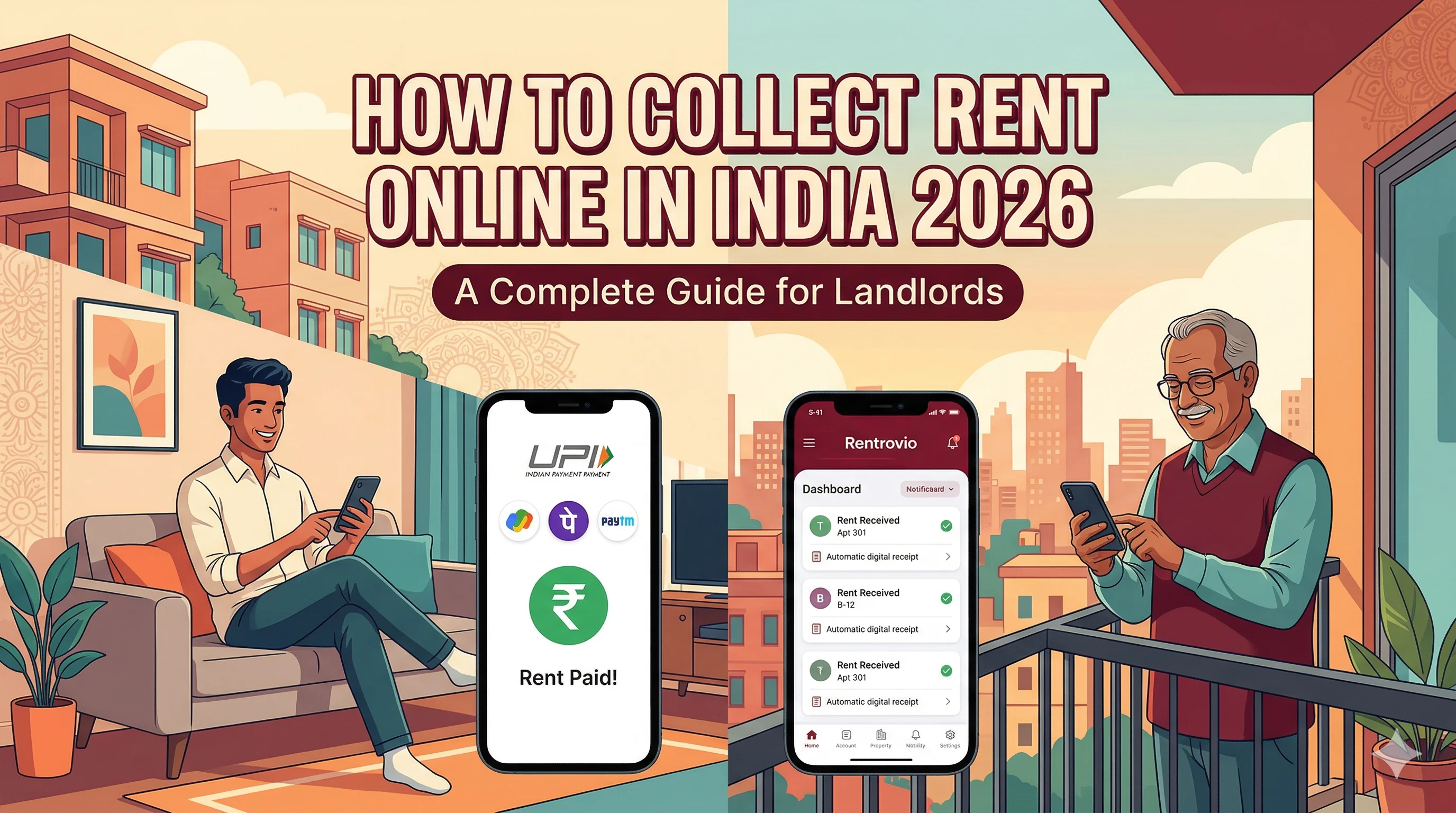
Key Takeaways
- UPI is the fastest and cheapest method for recurring rent collection in India.
- Dedicated apps provide automated reminders, payment tracking, and legal-grade digital receipts.
- Online payment records simplify TDS compliance, income declaration, and HRA documentation.
- Move beyond Google Pay and PhonePe — purpose-built rent apps offer receipts, ledgers, and tenant communication in one place.
If you are still chasing WhatsApp screenshots and bank SMS messages to confirm rent has been paid, you are not alone. Millions of Indian landlords manage rent collection manually, losing hours every month to reminders, reconciliation, and receipt-making. But in 2026, there is no reason to operate that way.
India's payments infrastructure — led by UPI — is among the best in the world. The tools now exist to make rent collection completely digital, auditable, and stress-free. This guide walks you through every method available, their pros and cons, and how to set up an end-to-end online rent collection system in under 30 minutes.
Why Collect Rent Online in India?
Traditional cash or cheque-based rent collection carries hidden costs that most landlords underestimate:
- Time loss: Physical collection or coordinating bank runs takes 2–4 hours per property per month.
- Dispute risk: Without documented receipts, both landlord and tenant are vulnerable to "paid / not paid" disagreements.
- Tax exposure: Undocumented cash rent makes income declaration difficult and invites scrutiny.
- Bounced cheques: A returned cheque means delayed rent plus bank charges for both parties.
Online rent collection solves all of these at once — for free or near-zero transaction cost.
Methods to Collect Rent Online in India
1. UPI (Unified Payments Interface)
UPI is the dominant digital payment method in India with over 500 million active users. For rent collection, landlords share their UPI ID (e.g., yourname@ybl) or a QR code with the tenant. The tenant pays from any UPI app — GPay, PhonePe, Paytm, BHIM — in under 10 seconds.
- Cost: Zero for person-to-person transfers; small MDR for business UPI IDs.
- Limit: ₹1 lakh per transaction (can be increased to ₹2 lakh for verified accounts on most banks).
- Speed: Instant, 24×7.
- Receipt: Basic bank notification only — no landlord-issued receipt unless you use a dedicated app.
Limitation: Generic UPI apps do not track rent history, issue legal receipts, or send tenant reminders. You still need to reconcile manually.
2. NEFT / IMPS / RTGS
Bank transfers remain the most common method for larger rental amounts above the UPI threshold, or where tenants prefer net banking. NEFT and IMPS are zero-cost for most bank customers, while RTGS (for amounts above ₹2 lakh) carries a nominal fee.
- NEFT: Batch-settled, available 24×7. Best for regular monthly rent.
- IMPS: Instant settlement, ideal for same-day rent payments.
- RTGS: For high-value transfers above ₹2 lakh; instant but carries a small charge.
3. Dedicated Rent Management Apps
This is the most powerful option for serious landlords. A purpose-built rent collection app like Rentrovio goes far beyond payment processing:
- Sends automated payment reminders 3–7 days before due date via WhatsApp, SMS, and push notification.
- Generates digital rent receipts instantly on payment confirmation.
- Maintains a complete payment ledger per tenant — useful for legal proceedings.
- Tracks overdue payments and late fees automatically.
- Provides dashboard visibility across all properties and tenants.
 Rentrovio Insight
Landlords using Rentrovio report a 58% reduction in late payments within the first three months, driven by automated reminders. The average time spent on rent collection drops from 4.5 hours to under 20 minutes per month per property.
How to Set Up Online Rent Collection: Step-by-Step
- Create your Rentrovio account — add property details and set the monthly rent amount and due date.
- Add your tenant — invite them via mobile number; they join as the linked tenant for that property.
- Configure payment settings — choose UPI or bank transfer, set grace period, and enable late fee rules.
- Activate automated reminders — set reminders at 7 days, 3 days, and 1 day before due date.
- Receive payment and auto-receipt — the moment payment is confirmed, Rentrovio issues a digital receipt to both landlord and tenant.
Total setup time: under 15 minutes for a single property.
Online Rent Collection and Tax Compliance in India
Digital rent collection creates a clean paper trail that simplifies tax filing significantly:
- ITR filing: Bank statements showing regular inward transfers make rental income declaration straightforward.
- TDS Section 194-IB: If your tenant's monthly rent exceeds ₹50,000, they must deduct 2% TDS. Online payment records make this traceable and compliant.
- HRA receipts for tenants: Salaried tenants need rent receipts to claim HRA exemption. Rentrovio auto-generates these, saving landlords the hassle of manual receipt creation.
Comparison: Generic UPI vs. Dedicated Rent App
| Feature | Generic UPI (GPay/PhonePe) | Rentrovio Rent App |
|---|---|---|
| Digital rent receipts | No | Yes (auto-generated) |
| Payment reminders | No | Yes (automated) |
| Late fee tracking | No | Yes |
| Multi-property dashboard | No | Yes |
| Payment ledger / history | Partial (bank SMS only) | Complete ledger |
| Transaction cost | Zero | Zero / minimal |
Getting Your Tenant to Pay Online
The most common challenge landlords face is tenant resistance to switching from cash. Here is how to handle it:
- Frame it as a benefit: Tenants no longer need to visit the landlord or carry cash. They pay in 10 seconds from their phone.
- Mention HRA receipts: Salaried tenants immediately see value — they get a proper rent receipt for their employer automatically.
- Include it in the rent agreement: Specify online payment as the agreed method when signing or renewing the lease.
- Start with UPI: Every smartphone user in India already has a UPI app. The learning curve is zero.
Frequently Asked Questions
What is the best way to collect rent online in India?
The most reliable way is through a dedicated rent collection app like Rentrovio that supports UPI, NEFT, and IMPS. These platforms auto-generate payment links, send reminders, and issue digital receipts — eliminating the manual follow-up landlords face with generic payment apps.
Is online rent collection legally valid in India?
Yes, online rent payments via UPI, NEFT, RTGS, or IMPS are fully legal in India. The Information Technology Act 2000 recognises electronic records, and Income Tax rules accept digital payment proof for rental income declarations and HRA claims.
Can I get a rent receipt for UPI payments?
Yes. When you collect rent through Rentrovio, the platform automatically generates a stamped rent receipt after each successful UPI or bank transfer, which tenants can use for HRA exemption filings with their employer.
Is TDS applicable on rent collected online in India?
TDS under Section 194-IB applies when an individual tenant pays rent exceeding ₹50,000 per month. This applies regardless of payment mode — cash or online. The tenant must deduct 2% TDS and deposit it with the government.
How do I track rent payments from multiple tenants?
Use a rent management platform like Rentrovio that provides a centralised dashboard showing payment status, outstanding dues, and payment history for all tenants across all properties in one place.
Start Collecting Rent Online Today
The transition from cash to online rent collection is one of the highest-leverage improvements an Indian landlord can make. It saves time, reduces disputes, creates a tax-ready audit trail, and makes your tenants' lives easier.
Whether you manage one flat or twenty properties, a purpose-built rent collection app is the right foundation. Combine it with a complete landlord management platform to handle agreements, maintenance, and caretakers alongside payments — all from one dashboard.

 Back to Blog