
Key Takeaways
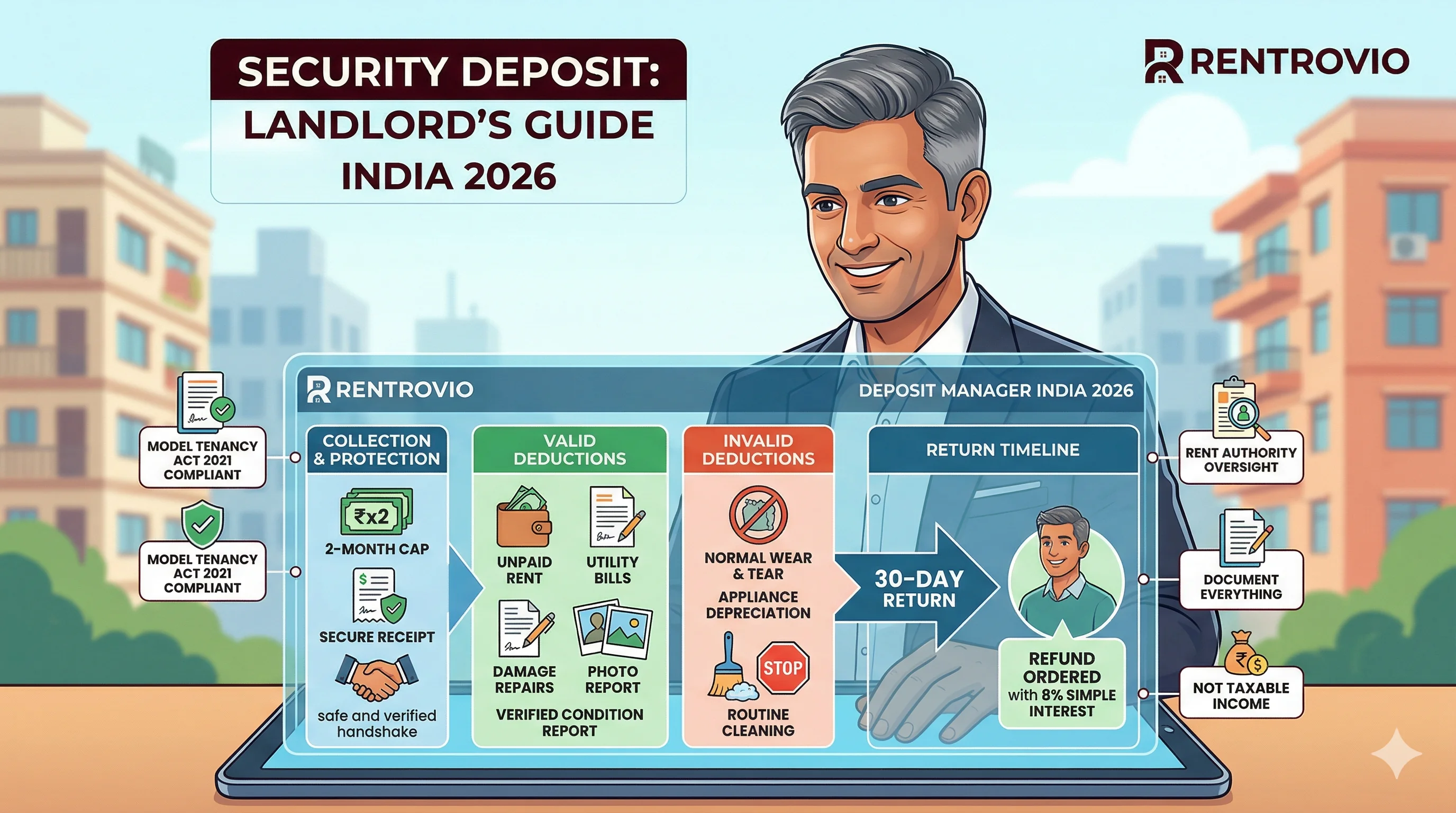
- The Model Tenancy Act 2021 caps residential deposits at 2 months' rent — many states still allow higher amounts under older laws.
- A security deposit is a liability, not income — do not spend it or mix it with operating funds.
- All deductions must be documented with bills, photos, and quotes — verbal justifications are unenforceable.
- Unjustified withholding can result in Rent Authority orders to return funds with 8% simple interest.
The security deposit is one of the most contentious topics in Indian rental relationships. Landlords see it as essential financial protection; tenants worry about unjustified deductions. Both perspectives are valid — the problem is almost always a lack of documentation and clarity.
This guide covers the legal framework, best practices for collection and management, what you can and cannot deduct, and how to return the deposit in a way that protects both parties.
Legal Framework: How Much Can You Charge?
India does not have a single national security deposit law — the rules depend on which state you are in and whether the Model Tenancy Act 2021 has been adopted:
| Category | Model Tenancy Act Limit | Typical Market Practice |
|---|---|---|
| Residential (urban) | 2 months' rent | 2–3 months (North India); 5–10 months (Bengaluru, Chennai, Hyderabad) |
| Commercial | 6 months' rent | 3–6 months widely; up to 12 months for prime locations |
| States not yet under MTA | Governed by state Rent Control Act or agreement | Varies — check state-specific rules |
South India vs North India: A stark regional divide exists. In Bengaluru, Chennai, and Hyderabad, it is common for landlords to charge 5–10 months as "advance" (de facto security deposit). In Delhi NCR, Mumbai, and most of North India, 2–3 months is the norm. The Model Tenancy Act would cap both regions at 2 months — states are still in various stages of adoption.
Documenting the Deposit Correctly
The deposit should be documented in the rent agreement with the following specifics:
- Exact deposit amount (in figures and words).
- Payment mode and date of receipt.
- Conditions under which deductions may be made.
- Return timeline (e.g., "within 30 days of vacant possession").
- Interest provisions (if any — most agreements specify nil interest on deposit).
Issue a formal receipt for the deposit payment at the time of collection — this is the foundational document in any future deposit dispute.
Move-In Documentation: Your Best Protection
The single most important practice for protecting your ability to make legitimate deductions at move-out is thorough move-in documentation. This means:
- Video walkthrough: A timestamped, dated video of every room, noting any existing damage, stains, or wear. Walk through with the tenant present.
- Condition checklist: A written checklist signed by both parties noting the state of walls, flooring, fixtures, fittings, appliances, and doors/windows.
- Meter readings: Record electricity, water, and gas meter readings on the date of possession.
- Photo set: Supplement the video with still photos of any specific areas of concern.
Without this documentation, a landlord claiming deductions for damage will struggle to prove that the damage existed at move-out and was not pre-existing.
What You Can (and Cannot) Deduct
Understanding the distinction between legitimate deductions and what crosses legal lines is critical:
| Legitimate Deduction | NOT a Valid Deduction |
|---|---|
| Unpaid rent at move-out | Normal paint touch-up from routine wear |
| Unpaid electricity / utility bills | Appliance depreciation from age (not misuse) |
| Repair of tenant-caused damage (holes in wall, broken tiles) | Flooring wear from normal foot traffic |
| Deep cleaning if property left in unsanitary condition | Routine cleaning between tenancies |
| Replacement of fittings deliberately removed or broken | Pre-existing damage not in move-in report |
| Unpaid society maintenance charges owed by tenant | Deductions without supporting bills/documentation |
Normal Wear and Tear
Courts consistently protect tenants against deductions for normal wear and tear. A 3-year-old wall with minor scuffs and faded paint in high-traffic areas is normal wear and tear — not tenant damage. If you want the walls repainted at end of tenancy, specify this in the agreement as a tenant obligation (common in upscale properties).
The Move-Out Process: Returning the Deposit Correctly
A structured move-out process is the best way to avoid deposit disputes:
- Schedule a joint inspection: Conduct the move-out walkthrough with the tenant present, using the move-in checklist as your reference. Note any new damage.
- Record meter readings: Get final electricity, water, and gas readings. Compare to move-in readings and calculate any outstanding bills.
- Collect all keys and access cards.
- Prepare a deductions statement: If making deductions, provide a written statement itemising each deduction with supporting bills and photos within 30 days.
- Return the balance: Transfer the remaining deposit (after valid deductions) within 30 days of vacant possession.
A well-run move-out process prevents the most common cause of deposit disputes: a landlord verbally declaring deductions 3 months later without documentation.
 Rentrovio's Deposit Tracking
Rentrovio records the deposit amount, payment date, and receipt in the tenancy record. Move-in and move-out condition reports can be logged with photos. When it is time to return the deposit, the deduction statement can be generated and shared digitally with full documentation — creating a transparent, defensible record for both parties.
Security Deposits and Tax: What Landlords Need to Know
A security deposit is not income when received — it is a refundable liability. Key tax considerations:
- Not taxable when received: A deposit received from a tenant is not added to income. It is a liability on your balance sheet.
- Interest on deposit: If you invest the deposit in a fixed deposit or savings instrument, interest earned is taxable income in your hands.
- Forfeited deposit: If a tenant defaults and you retain the deposit, the forfeited amount may be treated as income in that financial year.
- South India "advance" model: Large advance deposits (5–10 months) are sometimes used in lieu of monthly rent — the legal treatment varies and should be documented carefully in the agreement to avoid ambiguity.
Frequently Asked Questions
What is the maximum security deposit a landlord can charge in India?
Under the Model Tenancy Act 2021, the cap is 2 months' rent for residential properties and 6 months for commercial. States not yet under the MTA may have different limits or no limit. Market practice, particularly in South India, often exceeds the MTA cap — check your state's applicable law.
Within how many days must a landlord return the security deposit?
The Model Tenancy Act 2021 specifies 1 month (30 days) from the date of vacant possession. If the landlord fails to return within this period, the Rent Authority can order the return with 8% simple interest per annum. 30 days is also considered reasonable practice in states without the MTA.
What can a landlord legally deduct from the security deposit?
Valid deductions: unpaid rent, unpaid utilities, and cost of repairs for damage beyond normal wear and tear. Invalid deductions: normal wear and tear, appliance depreciation, routine cleaning, and pre-existing damage. All deductions must be documented with bills, receipts, and photographs.
Is the security deposit taxable income for landlords?
No. A security deposit is not income — it is a refundable liability. It is not taxable when received. However, interest earned on the deposit amount is taxable. A forfeited deposit (due to tenant breach) may be treated as income in the year of forfeiture.
What happens if a landlord refuses to return the security deposit?
A tenant can file a complaint with the Rent Authority (in Model Tenancy Act states) or a civil court. The Rent Authority can direct the landlord to return the deposit with 8% simple interest per annum for the delayed period. Documentation of the deposit payment is essential for the tenant's case.
The Right Tools Make Deposit Management Easy
Deposit disputes are almost always a documentation problem. With the right records — move-in report, photographs, signed condition checklist, and a clear deductions statement — a landlord can handle any deposit dispute confidently.
Rentrovio's best-in-class rent management app provides the full deposit lifecycle management — from recording the deposit at lease signing to generating the move-out settlement statement. Pair it with Rentrovio's landlord app to manage tenancy agreements, deposits, and digital rent collection in one unified platform.

 Back to Blog