
Key Takeaways
- Caretakers are the operational backbone of any multi-property rental business in India.
- WhatsApp-based task management creates confusion, missed follow-ups, and zero accountability.
- A digital task management system with photo completion proof transforms caretaker accountability.
- Rentrovio's dedicated Caretaker role gives structured, limited access without exposing sensitive landlord data.
Ask any mid-to-large Indian landlord what their biggest operational bottleneck is, and the answer is almost universally the same: "Managing my caretaker." Whether it is the caretaker who forgets to follow up on a plumber, the inspection that never happened, or the maintenance request that sat unaddressed for three weeks — poor caretaker management is the single largest driver of tenant dissatisfaction and property deterioration.
The problem is not that caretakers are inherently unreliable — it is that most landlords manage them through a chaotic mix of phone calls and WhatsApp messages with no structured system, no accountability, and no visibility. This guide shows you how to fix that.
What Is a Property Caretaker in India?
In the Indian rental context, a caretaker (also called a dekhbhal karne wala or watchman in informal usage) is someone who handles day-to-day operational tasks for a rental property on behalf of the landlord. The role is distinct from a property manager (who makes decisions) and a security guard (who provides physical security).
Typical caretaker responsibilities:
- Monthly or fortnightly property inspections
- Coordinating plumbers, electricians, and other vendors for repairs
- First-response contact for tenant maintenance requests
- Property upkeep when vacant (pest control, cleaning, basic security checks)
- Overseeing move-in and move-out — condition documentation, key handover
- Bill payments (electricity, water, maintenance society) if delegated
Why WhatsApp-Based Caretaker Management Fails
The most common "system" for caretaker management in India is a WhatsApp group or individual chat. While quick to set up, this approach has fundamental problems at scale:
- No task tracking: Messages get buried. There is no way to see which tasks are open, in progress, or completed.
- No accountability trail: "I already messaged about this" is impossible to verify when instructions blur into casual conversation.
- No completion proof: The landlord has to trust verbal confirmation — no photos, no timestamps.
- No history: Two months later, you cannot reliably reconstruct what was repaired, when, and at what cost.
- Information overload: For landlords with 5+ properties and multiple caretakers, WhatsApp becomes unmanageable quickly.
The Structured Caretaker Management Framework
Step 1: Define the Caretaker's Scope Precisely
Write a clear scope document — even a one-page list — covering:
- What they can authorise independently: Typically repairs under ₹2,000–₹5,000 without approval.
- What requires landlord approval: Any expense above the threshold, tenant disputes, lock changes, etc.
- Regular recurring tasks: Inspection frequency, bill payment schedule, reporting cadence.
- What they must never do: Collect rent in cash, modify rental agreements, make promises to tenants about deposit returns.
Step 2: Use Structured Task Assignment
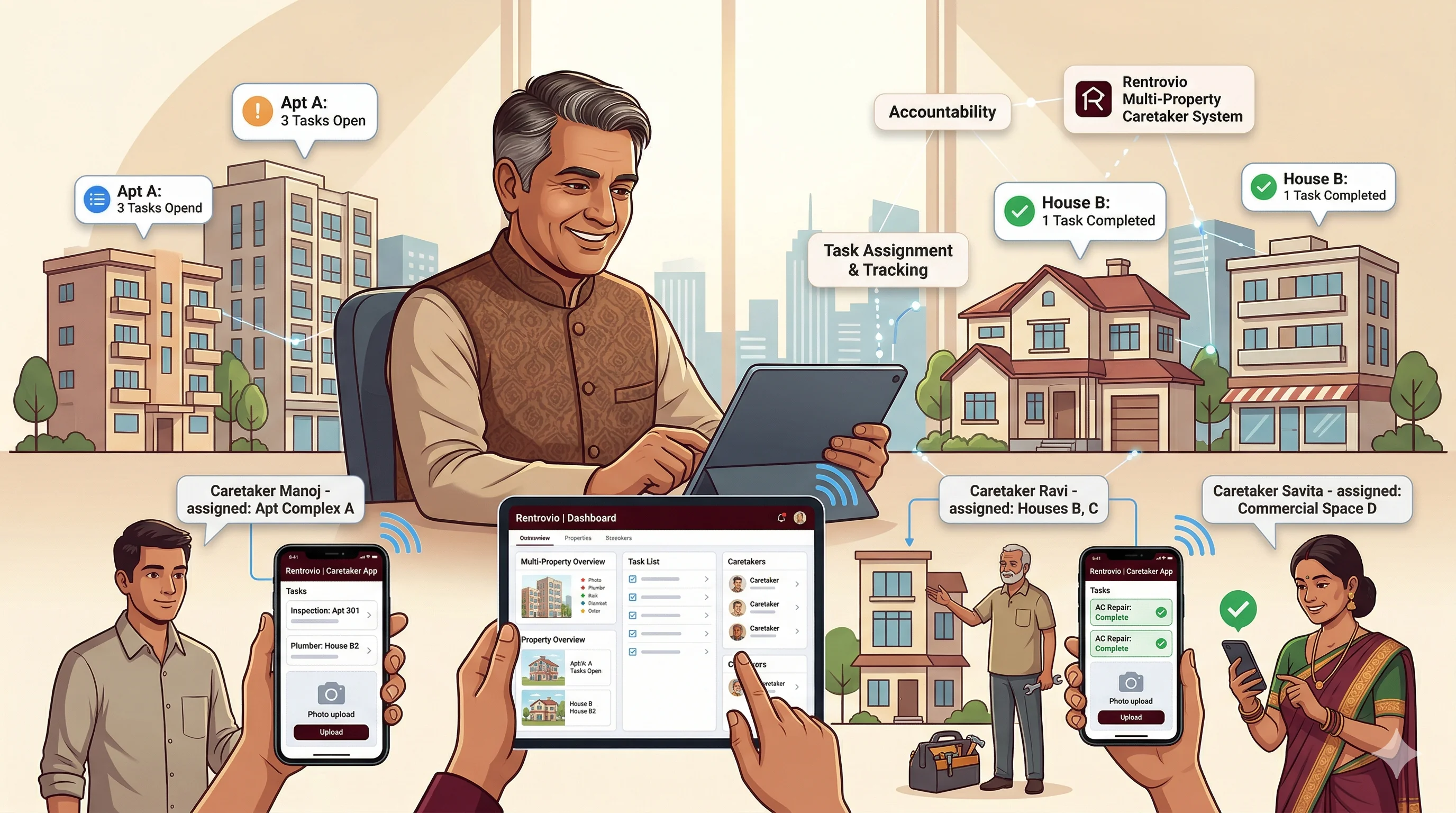
Replace ad-hoc messages with a formal task assignment system. Rentrovio's landlord management app has a dedicated Caretaker role with built-in task management:
- Landlord creates a task with deadline, priority, and linked property.
- Caretaker receives a push notification and can see all pending tasks in their app.
- Caretaker marks tasks as in-progress and completed — with optional photo attachments.
- Landlord sees real-time status updates on their dashboard.
- Overdue tasks are automatically flagged.
Step 3: Establish Inspection Protocols
Monthly property inspections are the most impactful single activity for property maintenance. Structure inspections with:
- A standard checklist (electrical, plumbing, walls, doors, common areas).
- Photo documentation requirement for any issue found.
- A condition score or simple pass/fail per area.
- Forwarding the report to the landlord via app — not a casual voice note.
 Rentrovio Insight
Landlords who implement structured inspection protocols through Rentrovio see a 45% reduction in emergency maintenance costs — because small issues are caught and fixed before they become expensive problems.
Caretaker Access: What They Should and Should Not See
Privacy and security are important when adding caretakers to a digital system. A well-designed platform gives caretakers access only to what they need:
| Feature | Caretaker Access | Landlord Only |
|---|---|---|
| Assigned maintenance tasks | Yes | — |
| Property inspection checklists | Yes | — |
| Tenant contact details | Limited (name + phone only) | — |
| Rent payment history | No | Yes |
| Rental agreements | No | Yes |
| Financial dashboard | No | Yes |
Managing Multiple Caretakers Across Properties
For landlords with 5+ properties spread across multiple areas, you may need different caretakers per location. Managing this manually becomes exponentially more complex. A digital platform solves the coordination problem:
- Assign each caretaker to specific properties — they only see tasks for their assigned properties.
- View all caretakers' task backlogs on a single landlord dashboard.
- Track which caretaker is overloaded vs. which has capacity.
- Review completion rates and response times per caretaker over time.
Caretaker Compensation Models in India
There is no standard caretaker fee in India — it varies by city, property type, scope of work, and whether the caretaker is resident or visiting:
- Resident caretaker (lives on premises, manages 1–4 units): Free or subsidised accommodation + ₹5,000–₹18,000/month depending on city. Mumbai and Delhi command the higher end.
- Visiting caretaker (checks in periodically): ₹2,000–₹8,000/month retainer or ₹500–₹2,000 per visit.
- Professional property management company: 5–12% of monthly rent, covers caretaker + tenant management + rent collection.
Frequently Asked Questions
What does a property caretaker do for an Indian landlord?
A caretaker handles on-ground operational tasks: property inspections, coordinating maintenance vendors, first-contact for tenant issues, overseeing move-in/move-out, and property upkeep when vacant. They execute tasks — unlike a property manager who makes decisions.
How can a landlord hold their caretaker accountable without being present?
Use a property management app with a dedicated caretaker module like Rentrovio. Assign tasks digitally; the caretaker marks completion and attaches photos. The landlord sees real-time status without phone calls or WhatsApp follow-ups.
Should I hire one caretaker for multiple properties or one per property?
For properties in the same building or nearby, one caretaker for 3–5 units is typical. For properties across different localities, you need separate caretakers per area. A digital system lets you manage multiple caretakers from one dashboard.
What is a fair caretaker fee for residential properties in India?
Resident caretakers: accommodation plus ₹5,000–₹18,000/month. Visiting caretakers: ₹2,000–₹8,000/month or ₹500–₹2,000 per visit. Professional management companies charge 5–12% of monthly rent.
What tasks should a landlord never delegate to a caretaker?
Never fully delegate: signing rental agreements, collecting or releasing security deposits, making major financial decisions like rent reductions, and any legal proceedings against tenants. These require direct landlord oversight or formal power of attorney authority.
Build a Reliable Caretaker System with Rentrovio
The transition from ad-hoc WhatsApp management to a structured digital caretaker system is one of the highest-leverage improvements a multi-property Indian landlord can make. It reduces emergency maintenance costs, improves tenant satisfaction, and gives you complete operational visibility — even from another city or country.
Rentrovio's landlord management platform is the only Indian rent management app with a dedicated, role-separated Caretaker workflow built in. Add your caretakers, assign properties, and transform how your rental portfolio operates.

 Back to Blog