
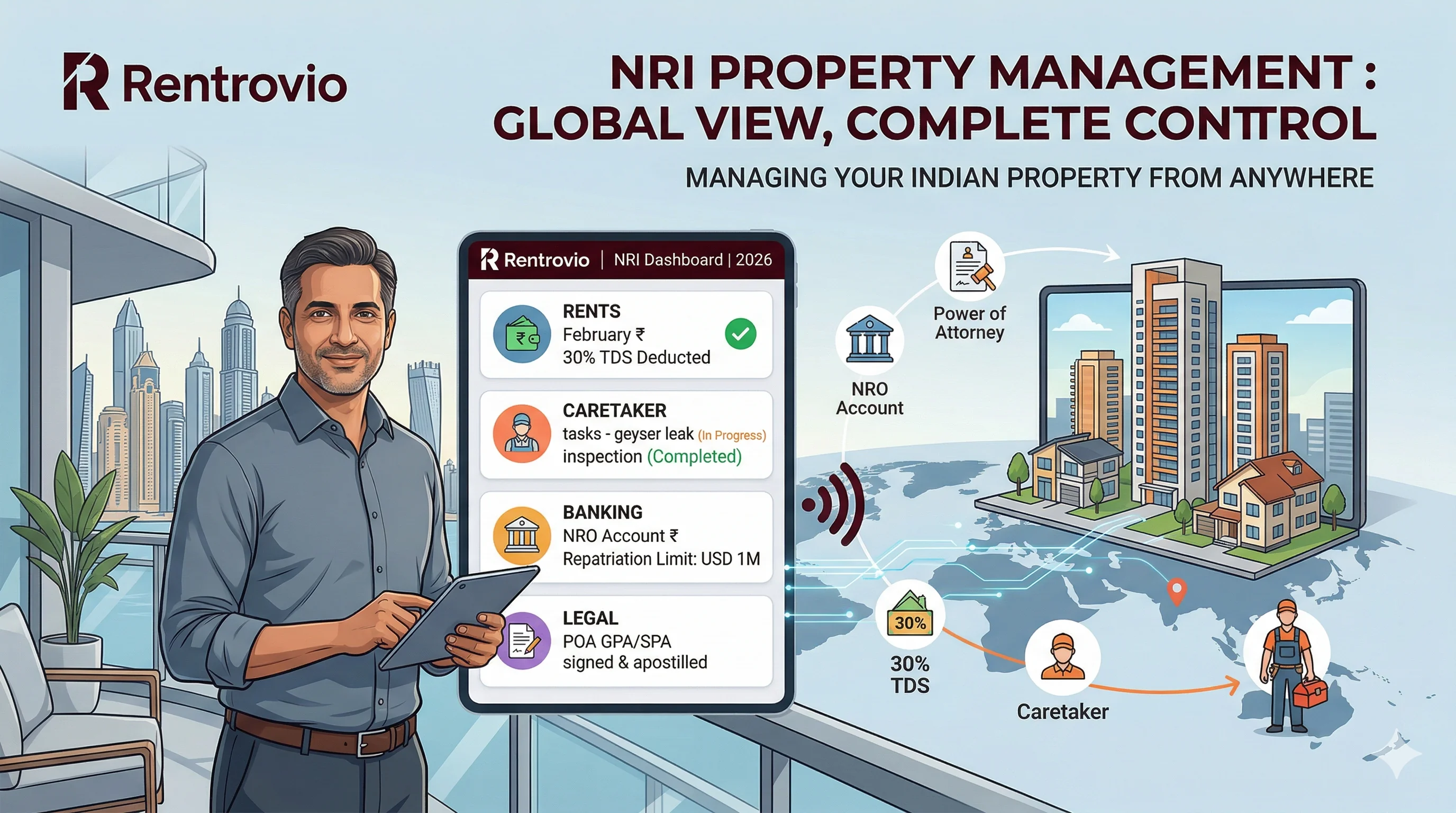
Key Takeaways
- TDS on NRI rental income is 30% (vs 2% for resident landlords) — tenants are legally responsible for deducting it.
- All Indian rental income must go to an NRO account; funds can be repatriated up to USD 1 million per year after taxes.
- A notarised, apostilled Power of Attorney is essential for seamless on-ground management.
- Digital landlord platforms like Rentrovio give NRIs complete remote visibility without depending on phone calls or in-person visits.
India has over 32 million Non-Resident Indians (NRIs) — and a significant proportion of them own property back home. Whether it is an inherited flat in Mumbai, an apartment in Bengaluru bought as an investment, or ancestral land in a tier-two city, managing this property from thousands of kilometres away is one of the most stressful things an NRI has to deal with.
The challenges are real: which tenant has actually paid this month? Is the caretaker actually showing up? Has the maintenance request been addressed? What is the TDS situation? This guide answers all of these questions and provides a framework for remote Indian property management that actually works.
1. TDS on NRI Rental Income: The Critical First Thing to Understand
This is where most NRI landlord-tenant relationships hit their first legal complication. Under Section 195 of the Income Tax Act, any person making a payment to an NRI is required to deduct TDS at source.
For rental income, the TDS rate is 30% of the gross rent (plus surcharge and cess, bringing it closer to 31–33% depending on the rent amount). This is dramatically higher than the 2% TDS applicable when a resident Indian individual tenant pays a resident Indian landlord more than ₹50,000/month.
Key obligations for tenants of NRI landlords:
- Obtain a TAN (Tax Deduction Account Number) before making the first payment.
- Deduct TDS every month and deposit it with the government by the 7th of the following month.
- File quarterly TDS returns (Form 27Q) with the Income Tax Department.
- Issue Form 16A (TDS certificate) to the NRI landlord after the quarter ends.
NRI Landlord Tip
If you have a lower expected tax liability (due to DTAA benefits with your country of residence), apply to the Assessing Officer for a Lower TDS Certificate under Section 197. This certificate allows your tenant to deduct TDS at a lower rate, improving your cash flow in India.
2. Banking: NRO Account for Rental Income
Under FEMA regulations, rental income earned in India must be credited to an NRO (Non-Resident Ordinary) account. Directing rent payments to an NRE (Non-Resident External) account is non-compliant.
Key characteristics of NRO accounts relevant to NRI landlords:
- Holds Indian rupee income from Indian sources (rent, dividends, pensions).
- Interest earned is taxable in India at 30% TDS.
- Repatriation permitted up to USD 1 million per financial year after payment of applicable taxes and submission of CA certificate (Form 15CB) and Form 15CA.
- Joint holding with a resident Indian relative is permitted.
Instruct your tenant to transfer rent directly to your NRO account via NEFT or IMPS after deducting TDS. Provide them with your NRO account number and IFSC code.
3. Power of Attorney: Your On-Ground Representative
A Power of Attorney (POA) is arguably the most important legal document for an NRI landlord. It authorises a trusted person in India — typically a family member, close friend, or professional property manager — to act on your behalf for property-related matters.
Types of POA and what each covers:
- General Power of Attorney (GPA): Broad authority — signing agreements, collecting rent, handling legal matters. Use with extreme caution and only with someone you completely trust.
- Specific/Limited POA: Restricted to defined activities (e.g., only signing lease agreements for a specific property). Safer and recommended for most NRIs.
How to execute a POA from abroad:
- Draft the POA document (consult a solicitor in India for the correct format).
- Have it notarised by a Notary Public in your country of residence.
- Get it apostilled (if your country is under the Hague Apostille Convention — UK, USA, UAE, Australia, Canada, etc.) or attested by the Indian Embassy/High Commission.
- Send the original to India — your representative registers it at the local Sub-Registrar's office if required.
4. Setting Up a Caretaker System
Even the best digital tools cannot replace a trusted person on the ground. For NRI landlords, a reliable caretaker is the difference between peaceful remote ownership and a constant stream of crises.
What your caretaker should handle:
- Periodic property inspections (ideally monthly).
- Coordinating maintenance and repairs with local vendors.
- First point of contact for tenant issues and emergencies.
- Overseeing move-in and move-out processes.
- Managing property when vacant — monitoring security, utility payments, etc.
Rentrovio's landlord management platform supports a dedicated Caretaker role — you can add your caretaker, define their access permissions, and they receive tasks, maintenance requests, and property inspection workflows directly through the app. You see everything they do in real time.
 Rentrovio Insight
NRI landlords using Rentrovio report that the Caretaker module eliminates 70% of WhatsApp and phone call communication with their on-ground representative. Structured task assignment and status updates replace ad-hoc check-ins — saving time across time zones.
5. Remote Rent Collection and Monitoring
The biggest fear for any NRI landlord is the question: "Has rent actually been paid this month?" Without a digital system, confirming this requires bank login checks, phone calls, or dependence on a WhatsApp message from your tenant.
A dedicated landlord management app solves this completely:
- Real-time payment notifications — know the moment rent is paid, regardless of your time zone.
- Automated payment reminders sent to tenants before due date — no manual follow-up required.
- Full payment history ledger per tenant and property.
- Outstanding dues dashboard showing overdue amounts and days past due.
- Digital receipts issued automatically — fully compliant receipts sent to tenant immediately after payment.
6. Tax Filing: What NRIs Must File in India
NRIs earning rental income in India must file an Indian Income Tax Return (ITR-2) if their Indian income exceeds the basic exemption limit. Key steps:
- Claim credit for TDS deducted by tenants — it will show in your Form 26AS / AIS.
- Declare gross rent under "Income from House Property" and claim the 30% standard deduction plus municipal tax deduction.
- If home loan EMI is being paid, interest deduction is available under Section 24(b).
- Check applicable DTAA (Double Tax Avoidance Agreement) between India and your country of residence to avoid double taxation.
Frequently Asked Questions
What is the TDS rate on rent paid to an NRI landlord in India?
Under Section 195, TDS on NRI rental income is 30% of gross rent (plus surcharge and cess). This is the tenant's legal responsibility. NRIs can apply for a Lower TDS Certificate if they expect lower tax liability due to applicable DTAA benefits.
Can an NRI give power of attorney to manage their Indian property?
Yes. An NRI can execute a General or Specific POA authorising a trusted person in India. The document must be notarised in the country of residence and apostilled or Embassy-attested before being used in India.
Is NRI rental income taxable in India?
Yes. Rental income from Indian property is taxable in India under "Income from House Property." After a 30% standard deduction, the net income is taxed. NRIs must file an Indian ITR if total Indian income exceeds the exemption limit. Check DTAA provisions for your country of residence.
Which bank account should an NRI use for rental income in India?
Rental income must be credited to an NRO account, not NRE. NRO funds can be repatriated abroad up to USD 1 million per financial year after taxes and required RBI documentation (CA certificate Form 15CB and Form 15CA).
How can an NRI monitor their Indian property remotely?
Combine a trusted local caretaker with a digital platform like Rentrovio. The caretaker handles on-ground tasks while Rentrovio gives you real-time payment visibility, maintenance tracking, and tenant communication — accessible from any country via mobile app.
Manage Your Indian Property with Confidence from Anywhere
NRI property management does not have to be a source of anxiety. With the right legal structures (POA, NRO account), a reliable caretaker, and a digital management platform, you can have complete visibility and control over your Indian property without being there.
Rentrovio's landlord management app is designed for exactly this use case — multi-property, multi-role management with real-time dashboards accessible globally. Start your free trial and see your Indian property from a completely different perspective.

 Back to Blog