
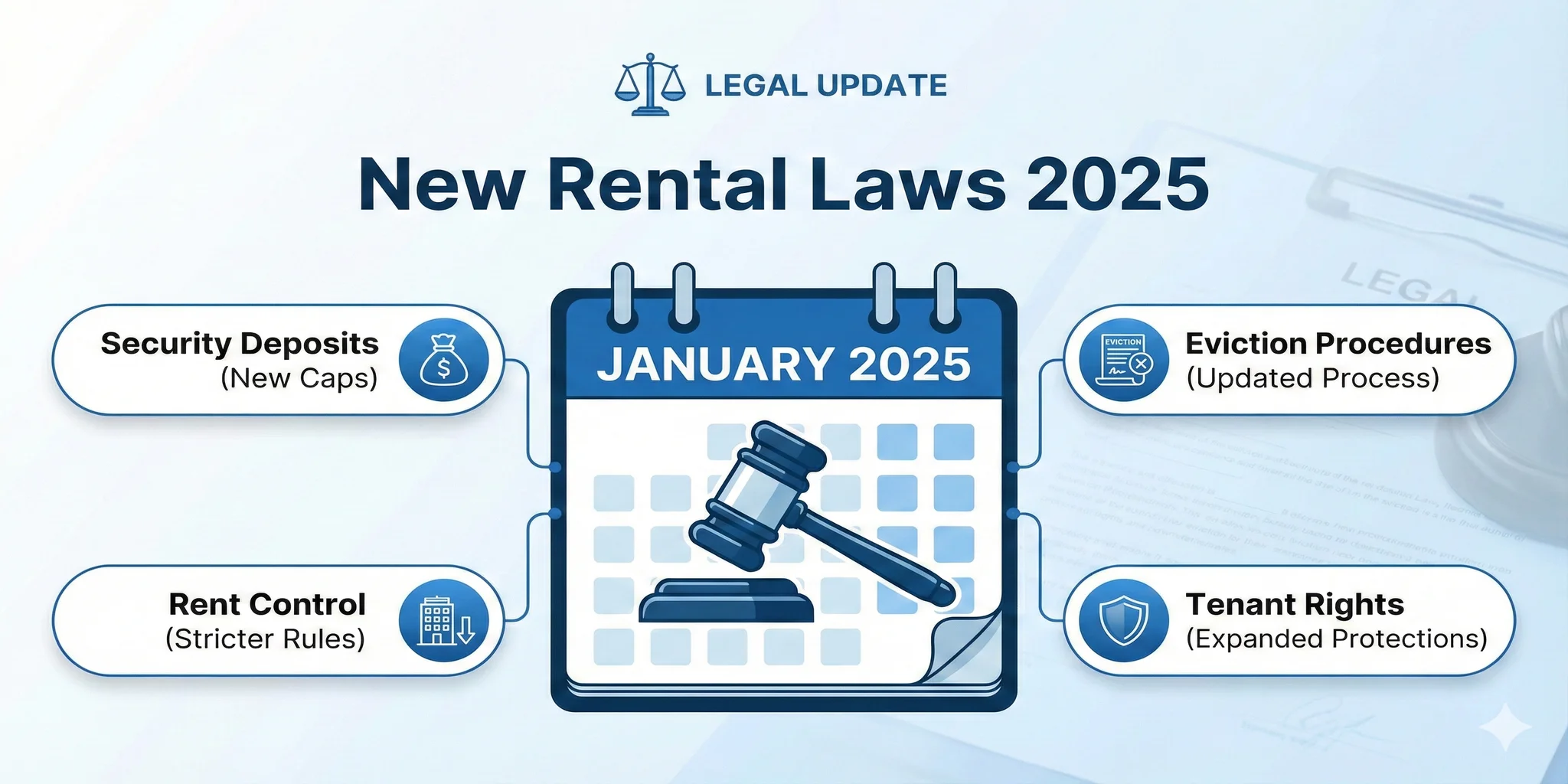
The rental housing landscape in India continues to evolve rapidly, with 2026 bringing significant legislative changes that will impact property managers, landlords, and tenants across India. From enhanced tenant protections to new disclosure requirements, staying compliant with these evolving regulations is crucial for successful property management.
Key Takeaways
- Model Tenancy Act 2021: 22 states have adopted or are in the process of adopting the MTA — security deposit capped at 2 months' rent for residential properties.
- Security Deposit Caps: Karnataka, Tamil Nadu, and Telangana still see 5–10 month advances; Delhi NCR and Maharashtra follow 2–3 month norms.
- Digital Agreements Legal: e-Stamping and Aadhaar eSign are now legally valid for rent agreements under the IT Act, 2000.
- TDS on Rent: Section 194-IB requires landlords to obtain PAN if monthly rent exceeds ₹50,000; tenant must deduct TDS at 5%.
- State Rent Control Acts: Delhi Rent Act 1995, Karnataka Rent Act 2001, and Maharashtra Rent Control Act 1999 still govern states that have not adopted the MTA.
The Model Tenancy Act 2021: Current Status
The Model Tenancy Act (MTA) 2021 was passed by the central government to replace outdated rent control laws and create a unified framework for rental housing across India. As of 2026, adoption is progressing state-by-state:
| Status | States/UTs |
|---|---|
| Fully adopted | Andhra Pradesh, Assam, Chhattisgarh, Goa, Gujarat, Haryana, Himachal Pradesh, Karnataka, Madhya Pradesh, Maharashtra, Odisha, Punjab, Rajasthan, Tamil Nadu, Telangana, Uttar Pradesh, Uttarakhand, Chandigarh, Delhi, Daman & Diu, Ladakh, Lakshadweep |
| Under consideration | Bihar, Jharkhand, Kerala, West Bengal |
| Not adopted | Arunachal Pradesh, Manipur, Meghalaya, Mizoram, Nagaland, Sikkim, Tripura |
Note: Even in states that have adopted the MTA, implementation at the municipal level varies. Always verify with your local Rent Authority or municipal corporation for the specific rules in your city.
Security Deposit Laws: What Each State Allows
Security deposit limits vary dramatically across India. Under the MTA, residential security deposits are capped at 2 months' rent. However, market practice and older state laws differ significantly:
| City / Region | Typical Deposit | MTA Cap Applicable? |
|---|---|---|
| Delhi NCR | 2–3 months | ✅ Yes (Delhi adopted) |
| Mumbai / Maharashtra | 2–3 months | ✅ Yes |
| Bengaluru / Karnataka | 5–10 months | ⚠️ Adopted but market practice exceeds cap |
| Chennai / Tamil Nadu | 6–10 months | ⚠️ Adopted but market practice exceeds cap |
| Hyderabad / Telangana | 5–8 months | ⚠️ Adopted but market practice exceeds cap |
| Kolkata / West Bengal | 2–3 months | ❌ Under consideration |
Eviction Process Under Indian Law
The eviction process in India depends on whether the property falls under the MTA or the state's existing Rent Control Act. Under the MTA, a landlord can evict a tenant for:
- Non-payment of rent — if the tenant fails to pay rent for 2 consecutive months or more.
- Subletting without permission — unauthorized subletting of the property.
- Property misuse — using the property for purposes other than what was agreed.
- Bona fide requirement — the landlord needs the property for personal use, repair, or reconstruction.
- Nuisance — causing disturbance to neighbours or violating society by-laws.
Timeline: Under the MTA, the Rent Authority must adjudicate eviction cases within 60 days of filing. In states without the MTA, eviction can take 6–24 months through civil courts. Always consult a lawyer before initiating eviction proceedings.
Digital Rent Agreements and e-Stamping
One of the most significant changes for 2026 is the widespread acceptance of digital rent agreements. Under the Information Technology Act, 2000, and the Indian Stamp Act, 1899 (as amended), e-stamped agreements executed with Aadhaar eSign are legally valid across India.
What you need for a valid digital agreement:
- e-Stamping: Purchase stamp paper online through the Stock Holding Corporation of India (SHCIL) or authorized state portals. Stamp duty varies by state — typically 1–2% of the annual rent.
- Aadhaar eSign: Both landlord and tenant sign electronically using Aadhaar OTP verification. This satisfies the "signature" requirement under the IT Act.
- Witnesses: Two witnesses must sign the agreement (physical or digital signatures accepted).
TDS on Rent: Section 194-IB Compliance
Under Section 194-IB of the Income Tax Act, any person (not a company) paying rent exceeding ₹50,000 per month must deduct TDS at 5% of the rent amount. Key compliance requirements for landlords:
- PAN is mandatory — provide your PAN to the tenant; without it, TDS is deducted at 20%.
- TDS certificate (Form 16C) — the tenant must issue Form 16C to the landlord within 15 days of each TDS deposit.
- Rental income appears in Form 26AS — ensure you declare all rental income in your ITR to avoid tax notices.
- No TDS if rent is below ₹50,000/month — but the tenant may still ask for PAN for HRA claims (threshold: ₹1,00,000 annual rent).
Key Rent Control Acts by State
For states that have not yet adopted the MTA, the following state-specific acts still govern rental relationships:
| State | Applicable Act | Key Feature |
|---|---|---|
| Delhi | Delhi Rent Act, 1995 | Standard rent fixation for properties above ₹3,500/month |
| Maharashtra | Maharashtra Rent Control Act, 1999 | Applies to Mumbai, Pune, Nagpur; standard rent provisions |
| Karnataka | Karnataka Rent Act, 2001 | Exempts properties above ₹15,000/month from rent control |
| Tamil Nadu | Tamil Nadu Regulation of Rights and Responsibilities of Landlords and Tenants Act, 2017 | Limited applicability; high-value properties exempt |
| West Bengal | West Bengal Premises Tenancy Act, 1997 | Standard rent and eviction protection for tenants |
2026 Compliance Checklist for Indian Landlords
Use this checklist to audit your current operations against the latest legal requirements:
| Category | Action Item | Priority |
|---|---|---|
| Rent Agreement | Ensure agreement is on e-stamp paper or digitally executed with Aadhaar eSign. Include all mandatory clauses: names, address, rent amount, deposit, period, notice period, and termination conditions. | High |
| TDS Compliance | If rent exceeds ₹50,000/month, verify tenant is deducting TDS at 5% and depositing it with the Income Tax Department. Ensure you receive Form 16C. | High |
| PAN Registration | Provide PAN to tenant if annual rent exceeds ₹1,00,000. Without PAN, TDS is deducted at 20% and tenant cannot claim HRA. | High |
| Security Deposit | Check your state's applicable deposit limit. If in MTA-adopted state, cap residential deposits at 2 months' rent. Issue a formal receipt for deposit collection. | Medium |
| Property Tax | Pay municipal property tax on time. Late payment attracts interest and penalties. Verify who is responsible under the agreement (usually the landlord). | Medium |
| Income Tax Filing | Declare all rental income under "Income from House Property" in your ITR. Claim the standard 30% deduction for maintenance and actual interest on home loan. | Medium |
📋 Rentrovio Insight: Automated Compliance
Staying compliant with changing rental laws across Indian states is a full-time job. Rentrovio automates compliance by maintaining up-to-date agreement templates aligned with the Model Tenancy Act and state-specific requirements. Our platform handles digital agreements with e-stamping, automated TDS tracking for high-value rents, and digital receipt generation that meets Income Tax requirements. Learn more about digital rent agreements.
Frequently Asked Questions
What is the maximum security deposit a landlord can charge in India?
Under the Model Tenancy Act 2021, the cap is 2 months' rent for residential properties and 6 months for commercial. However, states like Karnataka, Tamil Nadu, and Telangana still see market practices of 5–10 months. If your state has adopted the MTA, the 2-month cap is legally enforceable through the Rent Authority.
Can a landlord increase rent arbitrarily in India?
No. Under the MTA, rent can only be increased by a mutually agreed percentage at the time of lease renewal. There is no automatic annual increase unless specified in the agreement. For month-to-month tenancies, the landlord must typically provide 30 days' notice for any rent change.
Is a digital rent agreement legally valid in India?
Yes. Digital agreements executed with e-stamping and Aadhaar eSign are legally valid under the Information Technology Act, 2000, and the Indian Stamp Act, 1899. They are accepted as evidence in Rent Authorities and civil courts across India.
What happens if a tenant stops paying rent in India?
Under the MTA, the landlord can file an eviction petition with the Rent Authority if the tenant defaults on rent for 2 consecutive months. The Rent Authority must adjudicate within 60 days. The tenant is liable to pay the outstanding rent along with interest at the rate specified in the agreement or as determined by the Authority.
Does a landlord need to pay tax on rental income in India?
Yes. Rental income is taxable under the head "Income from House Property." Landlords can claim a standard deduction of 30% for maintenance and repairs, plus actual interest paid on home loan. If rent exceeds ₹50,000/month, the tenant must deduct TDS at 5% under Section 194-IB.
Conclusion
India's rental laws are undergoing the most significant transformation in decades. The Model Tenancy Act is creating a unified framework, digital agreements are becoming the norm, and tax compliance requirements are tightening. For landlords, staying informed is not optional — it directly impacts your rental income, legal standing, and tenant relationships.
The most important steps you can take today: (1) Verify your state's MTA adoption status and ensure your agreements comply. (2) Switch to digital agreements with e-stamping and Aadhaar eSign. (3) Set up proper TDS documentation if your rent exceeds ₹50,000/month. And (4) use a property management platform to track compliance across all your properties.
Disclaimer: This article is for informational purposes only and does not constitute legal advice. Rental laws vary significantly by state. Always consult with a qualified legal professional for your specific situation.

 Back to Blog